

In the face of frequent voltage dips, frequency drift, and ambient temperatures reaching 50°C in the Middle East, choosing the wrong power quality logger often means that the data collected on-site is worthless, or even the equipment is damaged on the spot.
If you want to truly capture meaningful power quality events in the Middle East, you should first focus on three easily overlooked key specifications when selecting a logger.

The input channel's withstand voltage and safety level are far more important than the sampling rate. The grid voltage in the Middle East is not a stable 230V; transient overvoltages often exceed 1000V. Don't be misled by the A/D conversion bit depth; first confirm whether the voltage input channel is rated to withstand continuous 600V Cat IV or at least 1000V Cat III. Cat IV means that the instrument can be directly connected to the busbar of the incoming line cabinet, and even in the event of a lightning strike or surge caused by a large motor switching, the instrument will not become a point of failure. We have seen too many loggers with a standard 300V Cat III configuration permanently go black during the first capacitor bank switch on-site. Additionally, check if the instrument is optimized for the 50Hz fundamental frequency. Many devices designed for 60Hz power grids experience phase-locked loop (PLL) lockout when handling frequency drift between 45Hz and 55Hz, resulting in incorrect harmonic data.
Power supply redundancy determines recording duration. Be aware that there may not be an electrical outlet readily available and that any voltage observed may not be stable. If the line voltage were to drop to zero volts, then any device connected to that line would immediately stop functioning, losing all of the data associated with the power outage event. Long-term monitoring can be achieved with recorders that have large capacity lithium batteries and can accept a wide range of DC voltage (i.e., 9-36 VDC) as an external power supply. Ideally, the recorder should automatically switch to using battery power when the external power supply has been interrupted and automatically save data prior to shutting down safely before the battery runs out of power.
Environmental tolerance is a basic requirement for a recorder to survive. We have seen instruments with internal short circuits caused by condensation in the UAE and Saudi Arabia, and we have also encountered cases where the display screen turned black directly in a 60℃ cabinet. Devices with a nominal operating temperature of 0~40℃ can only be used in air-conditioned rooms. For Middle Eastern applications, a model that maintains accuracy from -10°C to 55°C is required, along with rubber seals at the casing joints and an exposed terminal block. If used in coastal petrochemical or desalination environments, the corrosion rate of terminals from salt spray and hydrogen sulfide will be far faster than expected; gold-plated terminals or current clamp interfaces with anti-corrosion coatings will save you a lot of trouble.
Storage and communication logic must be adapted to intermittent networks. Power grid fluctuations often last for days or even weeks. Anyone trying to record a month's worth of waveforms and trends on a 16GB card will be disappointed. Calculations show that with 512 samples per cycle, three-phase voltage and current, and one trend block per minute, approximately 2GB or more of space would be needed per day. Choosing firmware logic that supports automatic compression recording and retains the first 10 cycles and the next 100 cycles upon event triggering is more practical than simply looking at the memory card size. Regarding communication, don't rely solely on 4G routers-remote substations may not have a stable signal at all. The instrument itself must have a USB or Ethernet port to support periodic manual data copying and allow operation to continue without reconfiguration after SD card insertion and removal. Avoid models that require resetting the transformer ratio and trigger threshold with every power outage and restart, as this is too tedious for field personnel.
The flexibility and phase recognition of the current probe are crucial. In most cases, you cannot disconnect the circuit, making a clamp-on current transformer (CT) the only option. Busbar spacing in Middle Eastern distribution panels is often very narrow and frequently has insulating sheaths, making it impossible for standard-diameter Rogowski coils to close. Confirm the wire diameter and clamp size of the current probe; a flexible Rogowski coil must be able to pass between adjacent busbars. Additionally, ensure the recorder can automatically identify the probe's direction and range, which significantly reduces wiring errors when multiple channels are connected simultaneously. For scenarios with variable frequency drive loads, an AC current probe with a bandwidth of at least 10kHz must be selected; otherwise, high-frequency components at the inverter switch edges will be completely missed, leading to misdiagnosis of motor overheating.
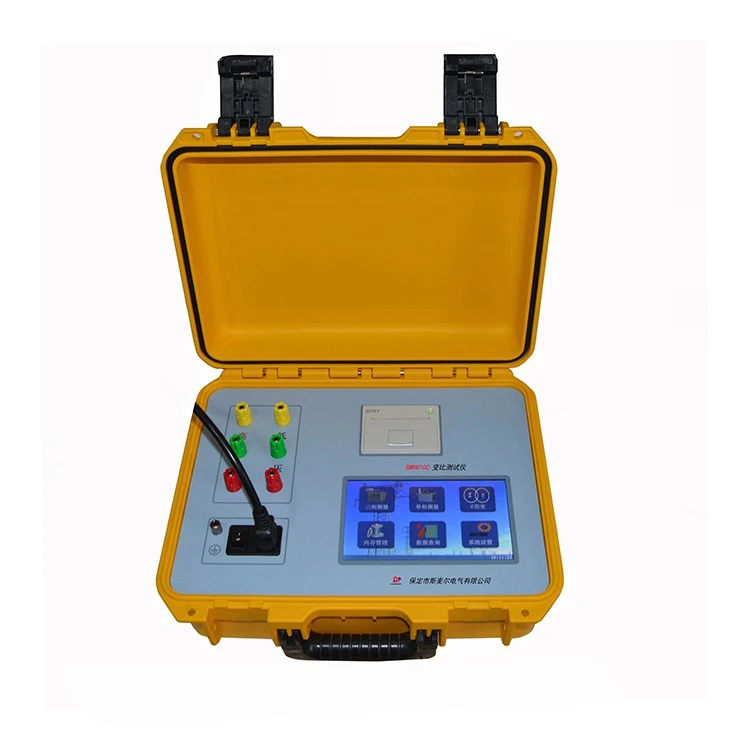
Finally, software logic is more important than visually appealing charts. A data logger that only provides a bunch of FFT spectra and fancy heatmaps, but doesn't offer compliance reports tailored to local regulations, is essentially useless. Ensure the manufacturer's software includes an assessment template similar to IEC 61000-4-30 Class A, allowing you to customize thresholds to match the local power company's requirements. The software should be able to generate EN 50160 reports offline, using red/green to indicate periods exceeding limits, so you don't need to provide additional explanations when submitting reports to the owner.
Problems with Middle Eastern power grids often stem from the accumulation of details-transients, harmonics, and frequency fluctuations occurring simultaneously. Only a sufficiently robust data logger can capture the true situation.


